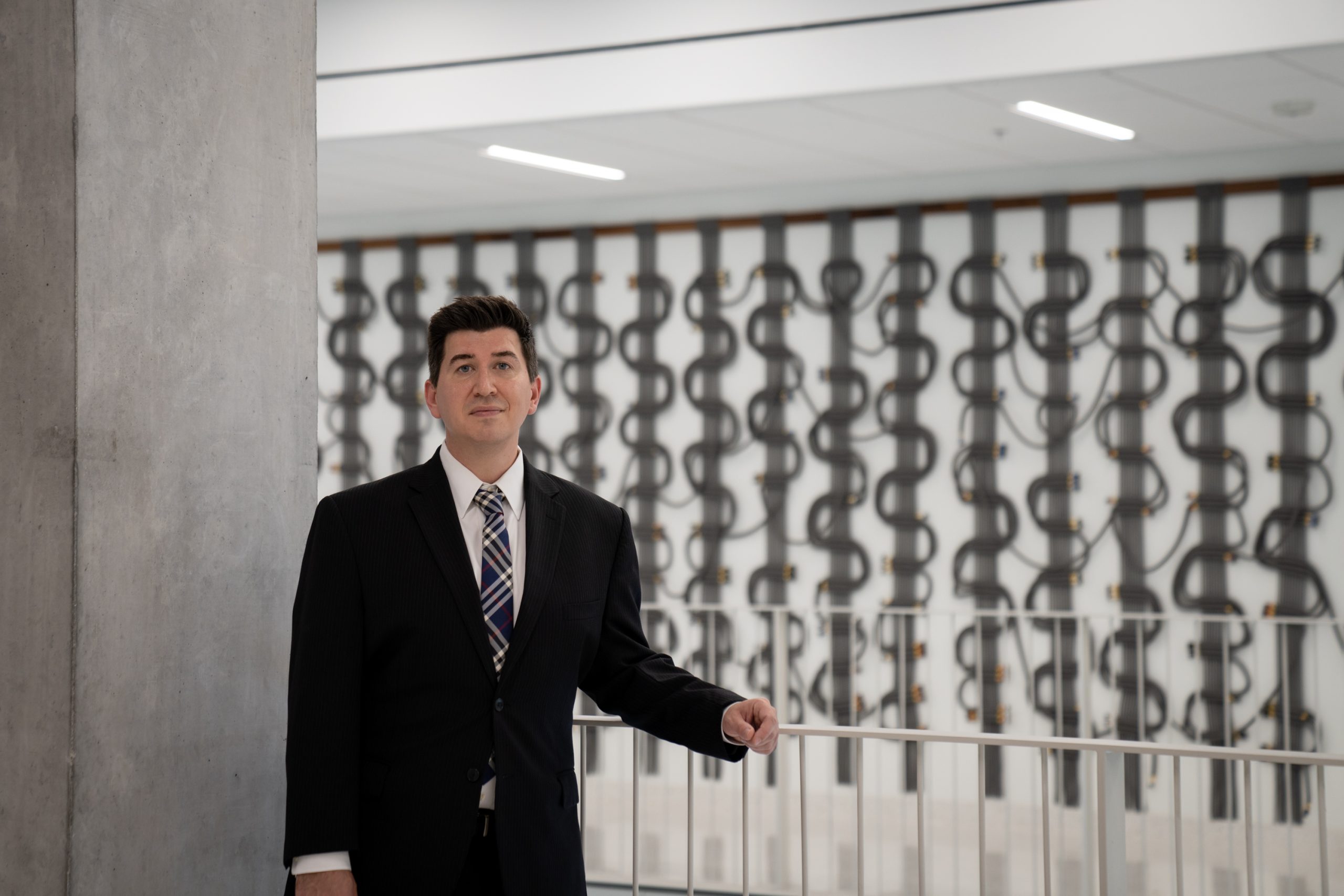
Zea Miller. Photo by Michel Thomas.
UF honors course explores use of AI in interstellar communication
Over 50 years after the idea of interstellar communication was first theorized, students at the University of Florida continue the mission of communicating with the stars, with the addition of a 21st-century technological marvel: artificial intelligence.
Through the new honors (Un)Common Writes course, Interstellar AI, students are challenged to re-create the original Pioneer 10 plaque and Voyager records, and imagine how an AI chatbot might help a user be informed about Earth if another craft were sent to the stars.
Assistant Instructional Professor Zea Miller said his course is paving the way for interdisciplinary AI studies by combining writing, rhetoric, semantics, semiotics, anthropology, philosophy, and so much more.
Interstellar AI is part of a rollout of six new honors courses created by the University Writing Program in collaboration with the UF Honors Program. The courses allow students the opportunity to work directly with instructors while expanding their writing skills, tapping into their creativity, and finding their voice. Fall 2024 was the first semester that (Un)Common Writing classes were offered.
With small class sizes, Miller said a learning environment is fostered where students encourage and support one another.
“We are able to share and collaborate on our work faster and more meaningfully,” he said. “Our conversations are natural. We can pivot quickly and easily. We can work both around one table and across all whiteboards together. In short, we are able to realize the academic dream.”
Miller said he hopes students take away how conceptualization has downstream effects on understanding and thinking. By recasting AI as a mode and not a tool, we create new conditions for collaborative work, he said.
“In the same way that UF is the leader for AI education, our writing program, with pioneering coursework in professional writing for AI, is a leader for AI and writing,” he said. “In this course, students create content with an AI, then create content to train an AI. We have not yet sent an AI into space, so the experience of doing something new, even as an exercise, prepares my students to thrive in new, AI-fueled spaces.”
Through using UF NaviGator AI, the university’s personal large language model processing site, Miller said students are not only prompting AI for content but also creating content for an AI to process.
“While what it means to be human is at the heart of our work, AI is helping us explore it,” he said.
Wesley Wolfe, a second-year finance major, said taking Interstellar AI has encouraged the use of combining AI and ideation, two fields not typically intertwined.
“I’ve taken (Un)Common Reads courses through the UF Honors Program in my past 2 semesters as well, but none have promoted this sort of abstract thinking and creativity,” he said.
Wolfe added there is an emphasis on not only “thinking outside the box” but also “burning the box entirely,” which shows how AI fits within the current zeitgeist.
“I’ve been able to challenge the way I typically go about tackling thought experiments and gain a new perspective on what makes people, people,” he said.
“I love this class so much that I look forward to every Monday,” said Zishu (Catherine) Zhao, a first-year student majoring in psychology and data science.
The main task of this class is to dive into deep history and every aspect of our human civilization and summarize it into different forms of representation to be sent into interstellar space, Zhao said.
“I would say this class is the most creative, imaginative, groundbreaking, and unconstrained course I have ever taken,” she said.
A brief history of interstellar communication
In 1960, in a laboratory at Stanford University, Ronald N. Bracewall theorized that the next step of human evolution would be sending messages into outer space. Interstellar communication would not be accomplished until more than a decade later, when a message on a plaque was affixed to NASA’s Pioneer 10 spacecraft.
Still barreling toward the star Aldebaran in the Taurus constellation, the spacecraft is not meant to reach its intended destination for more than 2 million years. The small, golden plaque depicts both male and female forms in relative size to the spacecraft. It also visualizes Earth’s location by detailing our solar system, with hopes of reaching other worlds.
In 1974, a deliberate radio message was broadcast into space from the Arecibo Observatory in Puerto Rico, with the purpose of calling on extraterrestrial life forms. Earth’s first attempt to “phone E.T.” was an elementary message, containing the formula for DNA, representations of the fundamental chemicals for life, a simplified drawing of our solar system, photographs of human beings and the Arecibo telescope.
Since then, other messages, plaques, and even songs on The Voyager’s Golden Record have been transmitted beyond Earth’s boundaries.
To this day, no aliens have taken up the offer to respond to any of the messages. Yet the purpose was not solely for communication, it was to show that the theoretical could be possible. In other words, the only limitation is the human imagination.


